
Argumentation Activities
Fact or Opinion?
This chapter has focused on the use of facts and opinions to build arguments. Recognizing the difference between fact and opinion is key.
Your Turn Select an article on the editorial page of a newspaper. Read the article, underlining facts and circling opinions. How much of the article is factual? How much is opinion based? How does this combination affect your perception of the article?
Deductive and Inductive Arguments
Deductive arguments guarantee their solutions by beginning with a general premise and ending with a specific conclusion. Inductive arguments create hypotheses by beginning with specific premises and deriving a general conclusion.
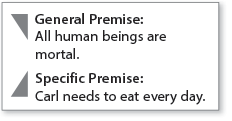
Your Turn Use the general premise as a starting point to create a deductive argument. Use the specific premise to create an inductive argument. Compare your arguments with those of a classmate.
Four Basic Propositions
On page 99, you learned about four basic propositions—the universal affirmative, the universal negative, the particular affirmative, and the particular negative. The following activity will help you think through these propositions.
Your Turn For each position, write your own example by replacing P and Q. Then answer the questions below.
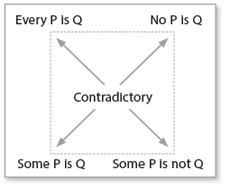
- Universal affirmative: Every P is Q.
- Universal negative: No P is Q.
- Particular affirmative: Some P is Q.
- Particular negative: Some P is not Q.
- If the universal affirmative is true, what other proposition is also true?
- If the universal negative is true, what other proposition is also true?
- If the universal affirmative is true, what other propositions must be false?
- If the universal negative is true, what other propositions must be false?
Rules of Inference
On page 100, you learned about nine rules of inference. This activity will help you review four of those rules.
Your Turn For each of the following rules of inference, write your own example by replacing P, Q, and R.
- Modus Ponens
(The way that affirms)If P then Q. ► P. ► Therefore Q.
- Modus Tollens
(The way that denies)If P then Q. ► Not Q. ► Therefore Not P.
- Hypothetical Syllogism
If P then Q. ► If Q then R. ► P. ► Therefore R.
- Disjunctive Syllogism
Either P or Q. ► Not P. ► Therefore Q.
Avoiding Logical Fallacies
Pages 108-112 provide examples of common logical fallacies. The activity below will help you practice them.
Your Turn Write your own example of each logical fallacy below.
- Bare assertions deny any opposing position by saying “that’s just the way it is.”
- Complex questions phrase an idea in a way that makes it impossible to counter.
- Correlation as causation wrongly asserts that because two things happen at the same time, they have a cause-effect relationship.
- False analogies compare situations to other situations that are not truly similar.
- False dichotomies simplify a complex situation into two extreme choices. This fallacy is also called either/or thinking.
- Appeals to ignorance say that something is false because no one has proved it, or that something is true because no one has disproved it.
- Attacks against the person criticize the individual rather than the person’s ideas. The Latin term for this is ad hominem, “to the person.”