582
To Run a Campaign
- Question the situation for the campaign.
- Subject: What does the campaign promote? What candidate or cause does it support?
- Purpose: Why am I running this campaign? To raise awareness? To support a cause? To support a candidate?
- Audience: Who is the target audience of this campaign? What does the audience want and need? How can I reach them?
- Plan your campaign by completing a planning sheet. (See page 361.)
- Profile: Learn about your target audience, including their wants and needs, interests and habits, and likes and dislikes.
- Connection: Brainstorm ways your campaign can reach your audience.
- Research your campaign.
- Develop a platform, plank, or slogan that meets the basic needs of your audience (see page 584).
- Enlist others to assist in your campaign.
- Create your campaign, considering the following publicity components:
- Posters: Provide an attention-grabbing image, catchy slogan, and important details. Post online and in print.
- Fliers: Create a paper-sized (or smaller) slip to distribute at school or in your community. Include a catchy headline and striking image or graphic.
- Campaign wear: Create campaign buttons, wrist bands, or T-shirts (see pages 584–585).
- Speeches: Write and deliver a speech in favor of the candidate or cause. (See pages 583.)
- School media: Write an article promoting your cause in the opinion section of your school newspaper.
- Social media: Use a variety of social media outlets to post information, video, and hyperlinks in support of the candidate or cause.
- Personal touch: Introduce yourself and your campaign to others. Shake hands, be enthusiastic, and encourage others to get involved.
- Improve your campaign.
- Evaluate: Does each part of the campaign achieve its goal and objectives? How has the audience received the campaign? How can it be improved?
- Revise: Remove parts that are not needed. Rework parts that don’t work well. Add new ways of reaching your audience.
- Perfect each part, making sure it is bold and persuasive.
- Present the campaign through posters, fliers, campaign wear, speeches, or social media. If possible, arrange a public debate with the opponent in an election campaign.
583
Campaign Speech and Poster
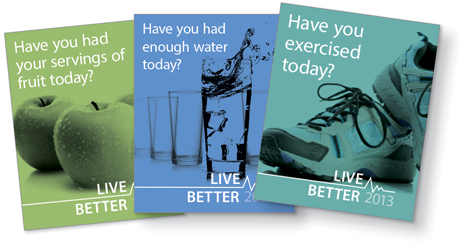
The following campaign speech and posters were built in support of a student wellness campaign.
Campaign Speech
Live Better 2013
The beginning engages the audience.Do you ever feel like you’re sleepwalking through the day? Does getting out of bed feel like a chore of epic proportions? Are you nodding off in class more than you’d like? Forget gas prices; high schoolers these days are enduring an energy crisis of our own. More and more, we turn to quick, carbonated pick-me-ups and ignore the real energy solution: wellness.
The middle explains the campaign and lists ways to get involved. The “Live Better 2013” campaign is out to improve our minds and bodies—and to provide us with the natural energy boost we need to stay focused in the classroom, on stage, and on the field. Each week we’ll post a new wellness tip in the cafeteria and locker rooms. To get started, here are some easy ways to live better in 2013:
The ending calls the listener to act.- Drink more water.
- Exercise for at least 30 minutes a day.
- Eat at least one serving of fruit with your breakfast.
Help make our school a healthier place. Join the “Live Better 2013” campaign and get busy living!
Campaign Posters
584
Targeting Your Campaign
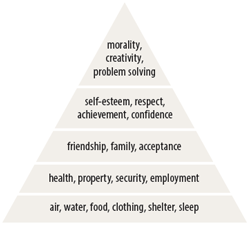
A campaign should target real needs in order to generate support and make a maximum impact. Before beginning your campaign, check if it addresses one or more of the needs on Abraham Maslow’s pyramid. The pyramid identifies a hierarchy of needs, starting with the most essential and working up toward those that help us reach our fullest potential. What needs does your cause or campaign address?
Your Turn Write down the needs you will address. For example, the campaign on the previous page addresses water, food, sleep, health, achievement, and confidence.
Planks
A plank is a statement that addresses a core idea connected to the audience’s needs. Political campaigns will often focus on a series of planks, which, when put together, make up the candidate’s platform. Effective planks target the needs of the audience.
Your Turn Write a series of planks for your campaign. Start by listing the needs. Then, for each need, complete the sentence “We believe that . . .“ by stating an idea that meets the need. Here’s an example from the wellness campaign:
Slogan
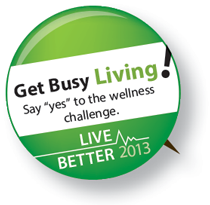
Every campaign needs a catchy slogan to generate interest and stick in people’s minds. Slogans should begin with command words.
Your Turn Write a slogan beginning with a command word and telling the reader what to do.
585
Publicity
Of course, a necessary component of any campaign is getting the word out and persuading others to join. There are many ways to promote a campaign:
- Posters and fliers provide eye-catching visuals and can be placed strategically to reach your target audience. Both posters and fliers should include an attractive and memorable headline or slogan, an engaging visual, and details about actions the viewer should take. Consider distributing them in print and online. (See sample posters and fliers on pages 428 and 531.)
- An event is a great way to gather people in support of a cause, but events require careful planning and execution. (See pages 572–575.) Events include rallies, demonstrations, fund-raisers, flash events, speeches, and debates.
- A speech can stir up support for your campaign. There are different approaches to writing and delivering speeches (see pages 552–557), though all speeches in support of a candidate or cause should be lively and engaging. Beyond words, the speaker can use tone of voice, facial expressions, and body language to demonstrate passion for the campaign.
- A debate is like a speech but also includes an opponent. In a debate, you argue in favor of your candidate or cause and in opposition to your opponent’s position. Debates help define an issue through argumentation and an exchange of ideas, but they should never resort to personal attacks. (See pages 560–563.)
- The “personal touch” means getting yourself out there and connecting on a personal level with your audience. This means speaking earnestly with people one-on-one, shaking hands, explaining what your campaign is trying to do, and offering ways to help. Remember to extend the “personal touch” beyond your immediate group of friends and family.
- Passing out campaign gear, such as buttons, T-shirts, and wrist bands, can help you break the ice with potential supporters. Make sure your campaign materials fall within your budget.
- Social media allow you to deliver your message to anyone in the world in a timely manner, making it a powerful and efficient avenue for publicity. The best social media campaigns take advantage of diverse social forms, including short messages, Web links, or audio and visual media. (For more on using social media to support a campaign, see pages 286–287.)
Your Turn Decide which types of publicity you will use to promote your campaign.